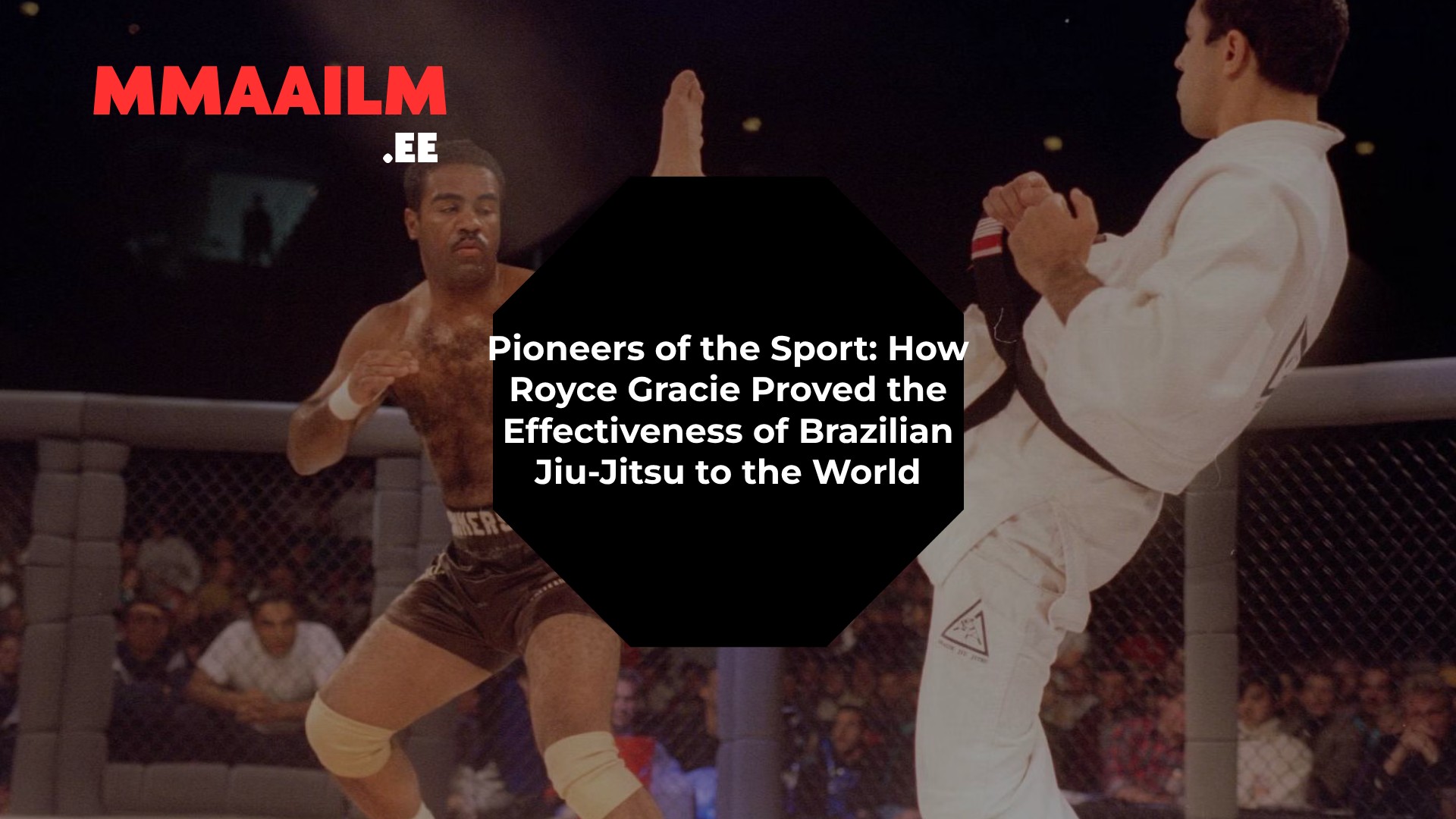
Before November 12, 1993, the global perception of martial arts was largely shaped by Hollywood action films and traditional striking disciplines. Karate, Taekwondo, and Kickboxing reigned supreme in the public imagination, and grappling was widely dismissed as ineffective in a real physical confrontation. That paradigm was shattered in a single night in Denver, Colorado, during the inaugural Ultimate Fighting Championship (UFC 1). A slender, unassuming Brazilian named Royce Gracie entered an eight-man, no-weight-class tournament and submitted three larger, stronger opponents with ease. In doing so, he not only proved the devastating effectiveness of Brazilian Jiu-Jitsu (BJJ) but also laid the foundational blueprint for modern mixed martial arts.
The Master Plan Behind the First Ultimate Fighting Championship
UFC 1 was not a spontaneous gathering of fighters eager to test their skills; it was a carefully orchestrated event co-created by Art Davie and Rorion Gracie. The tournament was designed with a specific purpose: to serve as a global showcase for the superiority of Gracie Jiu-Jitsu. The rules—or rather, the lack of them—were intentionally minimal. There were no weight classes, no time limits, and no judges, creating an environment where a patient grappler could thrive without the threat of a referee standing the fighters up.
When it came time to select a representative for the Gracie family, the choice was highly strategic. While it was widely acknowledged within the family that Rickson Gracie was their most formidable and experienced fighter, Rorion intentionally selected his younger brother, Royce. Rickson was heavily muscled and physically intimidating. Royce, weighing between 170 and 175 pounds with a slight build, looked like an average person. The family knew that if a physically unassuming fighter could defeat massive, muscular opponents, the public would have no choice but to attribute the victory to the martial art’s technique rather than the athlete’s brute strength.
Dismantling the Hollywood Martial Arts Myth
Prior to Royce Gracie’s televised victories, most martial artists believed that a fight would be decided by a single, powerful strike. Gracie’s technical approach dismantled this theory by utilizing a methodical, three-phase system designed to neutralize striking power and drag opponents into deep water.
- Distance Management: Gracie rarely engaged in traditional striking exchanges. Instead, he used long front kicks and oblique kicks (stomps to the knee) to keep dangerous strikers at bay. These strikes were not intended to cause knockout damage, but to create a safe entry point to close the distance.
- The Clinch and Takedown: Once inside his opponent’s striking range, Gracie would immediately tie up their arms. By securing a tight clinch, he effectively neutralized their ability to generate punching power. From there, he utilized fundamental judo and wrestling trips to drag the fight to the canvas.
- Ground Control and Submission: On the ground, Gracie operated in a realm his opponents did not understand. He used positional dominance—such as the mount or back control—to trap opponents. When on his back, he utilized the closed guard to stay safe and attack. He then applied leverage-based joint locks and chokes to force a submission.
The Mechanics of Leverage and Patience
The core philosophy of Brazilian Jiu-Jitsu is that a smaller, weaker person can successfully defend against and defeat a larger, stronger assailant by using proper leverage and weight distribution. Gracie demonstrated this masterfully. Because his early UFC opponents had virtually no knowledge of submission grappling, they routinely made critical errors on the ground. They would extend their arms to push him away, leaving themselves vulnerable to armbars, or turn their backs to escape, offering up their necks for chokes.
Furthermore, Gracie utilized the traditional Gi (kimono) to his advantage. He frequently used the lapels of his own Gi, or his opponent’s clothing, to secure tight strangulations. His patience was just as important as his technique. Without time limits to force the action, Gracie was content to hold a safe position, let his larger opponents exhaust themselves through frantic, ineffective movements, and then capitalize on their fatigue.
Landmark Victories That Changed the World
During his initial run from UFC 1 to UFC 4, Gracie amassed an incredible 11-0 record (with one withdrawal due to exhaustion), finishing every single opponent by submission. Several of these bouts remain defining moments in martial arts history.
UFC 1 vs. Ken Shamrock: Shamrock was a physically imposing shoot wrestler who actually understood grappling and leg locks. Despite Shamrock’s grappling pedigree, Gracie used his Gi to secure a choke from the back, forcing Shamrock to tap out in just 57 seconds. This proved BJJ’s superiority not just against strikers, but against other grappling styles of the era.
UFC 1 vs. Gerard Gordeau: In the tournament final, Gracie faced a highly dangerous Savate champion who had violently knocked out his previous opponent. Gracie executed his game plan perfectly: he secured the takedown, achieved the mount position, and transitioned to a rear-naked choke to win the first UFC tournament.
UFC 4 vs. Dan Severn: This bout is often cited as the ultimate David versus Goliath matchup. Severn was a world-class wrestler who outweighed Gracie by over 80 pounds. Severn took Gracie down and maintained top position for over 15 minutes, raining down heavy pressure. Gracie demonstrated immense patience and defensive guard retention, surviving the onslaught until he eventually caught the exhausted Severn in a triangle choke. It was a masterclass in surviving from the bottom and using an opponent’s fatigue against them.
Common Misconceptions About the Early UFC
While the legend of Royce Gracie is well-documented, several misconceptions about his early UFC run persist today. The most common is the idea that he fought in a completely “no rules” environment. While the rules were incredibly sparse compared to modern MMA—forbidding only biting and eye-gouging—the specific format was heavily tailored to favor a grappler. The lack of time limits and the absence of referee stand-ups were the crucial variables that allowed Gracie’s patient, methodical ground game to work. If modern MMA rules (five-minute rounds, referee interventions, and mandatory gloves) had been in place, his strategy would have required significant adjustments.
Another misconception is that the early UFC events were purely objective sporting contests. In reality, they were designed as infomercials for Gracie Jiu-Jitsu. The cage design, the matchmaking, and the ruleset were all cultivated by Rorion Gracie and Art Davie to ensure the grappling arts had the highest possible chance of success against traditional strikers.
An Undeniable Legacy in Mixed Martial Arts
Regardless of the tailored rulesets of the early 1990s, Royce Gracie’s achievements remain monumental. He entered an arena against massive, terrifying opponents and proved that technique, leverage, and a deep understanding of ground fighting could conquer brute strength.
In 2003, Royce Gracie was rightfully inducted as the first member of the UFC Hall of Fame, alongside his former rival Ken Shamrock. His performances in UFC 1, 2, and 4 did more than just win tournaments; they forced an evolutionary leap in martial arts. After witnessing Gracie’s dominance, fighters around the world realized that striking alone was no longer enough. To survive in a real fight, one had to learn how to grapple. In proving the effectiveness of Brazilian Jiu-Jitsu to the world, Royce Gracie effectively birthed the modern, multi-disciplined sport of mixed martial arts.