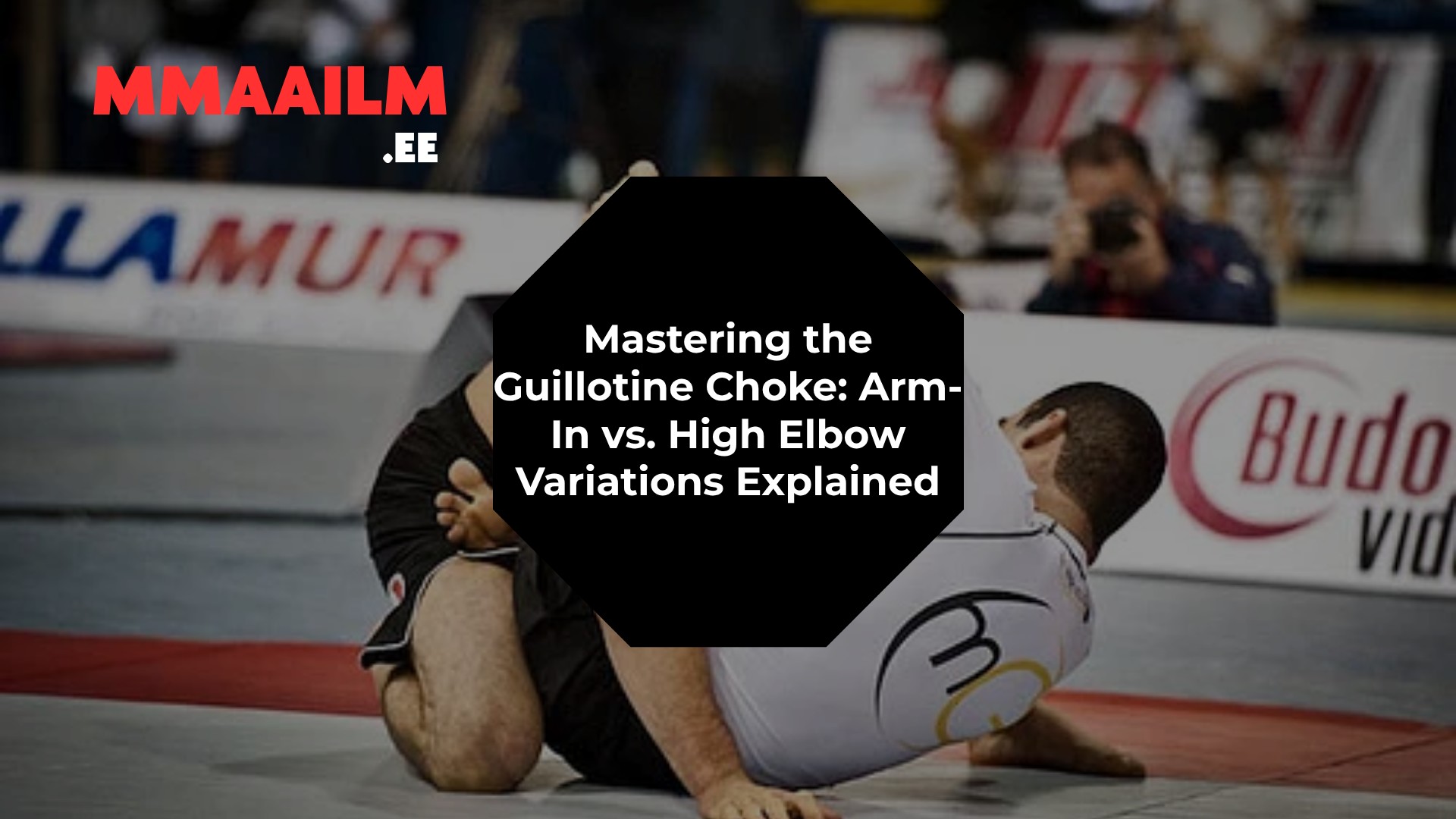
The guillotine choke is one of the most foundational and devastating submissions in both mixed martial arts and Brazilian Jiu-Jitsu. Executed from a front headlock position, the technique involves wrapping an arm around an opponent’s neck to apply pressure to the carotid arteries, the trachea, or both. However, as grappling has evolved, so too have the mechanics of this classic submission. Modern grapplers generally rely on two primary variations to finish the fight: the arm-in guillotine and the high elbow guillotine, frequently referred to as the Marcelotine.
Understanding the technical differences between these two variations is crucial for any martial artist. Choosing the correct application depends heavily on the opponent’s posture, their defensive reactions, and the attacker’s immediate tactical goals—whether that means securing a quick tap or establishing dominant positional control.
The Anatomy of the Front Headlock
Before dissecting the variations, it is important to understand the foundational front headlock position. A front headlock occurs when an attacker is facing their opponent and secures control over their head and neck, typically during a scramble, a sprawling takedown defense, or from the guard.
From this position, the attacker’s primary goal is to break the opponent’s posture. A successful guillotine choke requires the attacker to connect their hands and use their body positioning to compress the space around the opponent’s neck. The grip configuration and the placement of the attacker’s secondary arm dictate whether the choke will become an arm-in or a high elbow variation.
The Arm-In Guillotine: Control and Versatility
The arm-in guillotine is characterized by trapping one of the opponent’s arms inside the choking loop alongside their head. This variation is highly versatile and is often favored by grapplers who prioritize positional dominance and control over an immediate submission.
Because the opponent’s arm is trapped, their ability to base out, posture up, or defend with that limb is severely compromised. The mechanics of finishing the arm-in guillotine rely heavily on full-body positioning rather than arm strength. The attacker must use their legs and hips to create a sharp angle, utilizing an abdominal crunch to compress the neck rather than simply pulling upward with the shoulders.
- Positional Control: The trapped arm allows the attacker to off-balance the opponent effectively. If the initial choke fails, the grip provides excellent leverage for sweeps, particularly from the butterfly or closed guard.
- Transitional Threat: The arm-in grip serves as a central hub for other head-and-arm chokes. If the opponent defends the guillotine, the attacker can seamlessly transition to a D’Arce or Anaconda choke.
- Choking Mechanics: If the angle is not perfectly adjusted, the arm-in variation can sometimes act as an air choke or a neck crank. Precise hip engagement is required to turn it into a clean blood choke.
The High Elbow Guillotine (The Marcelotine)
Popularized by multiple-time BJJ world champion Marcelo Garcia, the high elbow guillotine revolutionized front headlock attacks. Unlike the arm-in variation, the Marcelotine is executed without trapping the opponent’s arm. Instead, the attacker secures a specific grip—often a ball-in-socket or chin-strap grip—and flares their non-choking elbow high over the opponent’s shoulder.
This high elbow placement is a masterpiece of skeletal framing and leverage. By driving the secondary elbow high across the opponent’s upper back or shoulder, the attacker creates a structural wedge. This wedge effectively stops the opponent from utilizing the most common guillotine escapes: circling away to the safe side or rolling over the choking arm.
The Marcelotine is highly regarded as a reliable blood choke. The mechanics of the high elbow force the choking forearm deep into the opponent’s carotid arteries, creating immense upward pressure that can render an opponent unconscious in seconds.
Leverage and Positioning: Structure Over Squeeze
A common misconception among novice grapplers is that finishing a guillotine requires maximum squeezing power. Relying solely on arm strength is not only inefficient but also leads to rapid muscular fatigue, leaving the attacker vulnerable if the opponent escapes.
Proper execution of both variations relies on leverage, leg positioning, and core contraction. In the arm-in guillotine, the attacker’s legs must climb high on the opponent’s back to break their posture, while the hips shift to the side to create the choking angle. In the high elbow variation, the structural frame of the raised elbow does the heavy lifting, allowing the attacker to finish the choke with a subtle core crunch rather than a frantic squeeze.
Situational Strategy: When to Choose Which Variation
Deciding between the arm-in and high elbow guillotine often comes down to the specific scenario and the opponent’s immediate reaction.
| Scenario | Recommended Variation | Strategic Reasoning |
|---|---|---|
| Defending a Double-Leg Takedown | High Elbow (Marcelotine) | When an opponent shoots and leaves their neck exposed, the high elbow creates an immediate wedge, stopping their forward drive and securing a rapid finish before they can settle into top position. |
| Working from Guard/Bottom Position | Arm-In Guillotine | Trapping the arm limits the top player’s ability to base out or strike. It allows the bottom player to threaten the choke while simultaneously setting up sweeps to gain the mount. |
| Opponent Fights the Hands | Arm-In Guillotine | If the opponent successfully strips the initial chin-strap grip required for a high elbow, transitioning to an overhook on their arm secures the arm-in position, maintaining control and opening up transition pathways. |
Addressing Common Misconceptions
Despite their widespread use, several myths surround the application and effectiveness of these guillotine variations.
- Myth: The arm-in guillotine is a low-percentage submission that only works on smaller opponents.
Reality: The arm-in guillotine is highly effective at the elite level of MMA and grappling. Its success rate drops only when attackers fail to create the necessary hip angle, relying instead on a straight-back pull. When the mechanics are understood, it is a devastating technique regardless of the opponent’s size. - Myth: The high elbow guillotine requires extraordinary flexibility.
Reality: While Marcelo Garcia’s application is famous, the mechanics rely on leverage and framing rather than extreme flexibility. By properly securing the chin strap and connecting the hands correctly, grapplers of all body types can achieve the high elbow position. - Myth: The guillotine is purely an offensive weapon.
Reality: Both variations are exceptional defensive tools. The threat of a guillotine forces opponents to abandon takedowns, alter their guard passes, and concede positional advantages to protect their neck.
Mastering both the arm-in and high elbow guillotine variations provides a martial artist with a comprehensive front headlock system. By understanding the distinct mechanics, structural requirements, and situational applications of each, grapplers can transform a simple headlock into a dual threat of inescapable control and fight-ending submission.