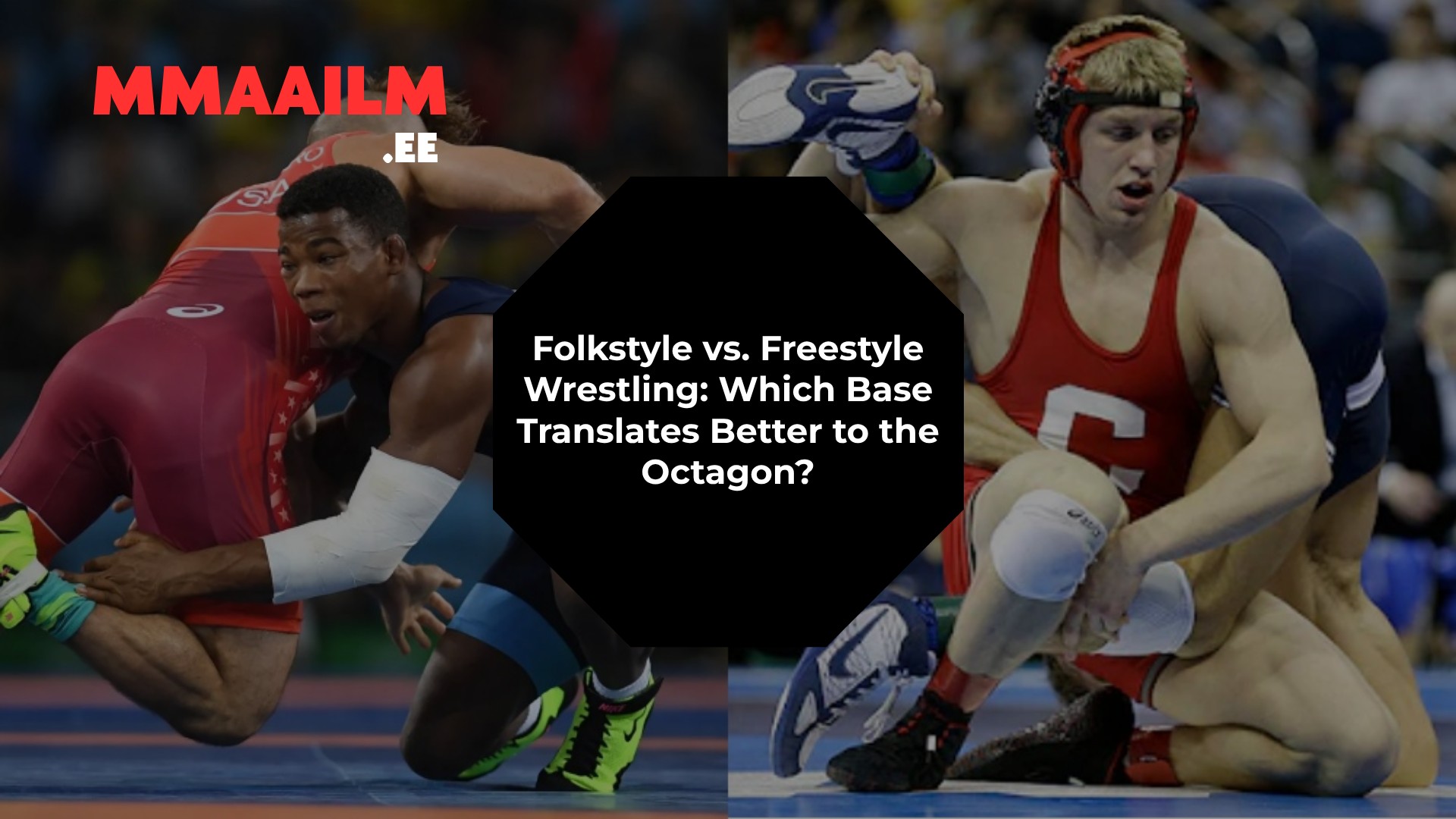
Wrestling has long been considered the most dominant base in mixed martial arts. The ability to dictate where a fight takes place—whether keeping it on the feet or dragging it to the canvas—provides a massive tactical advantage. However, when analysts and coaches discuss a fighter’s wrestling pedigree, they are often referring to distinct rule sets that forge entirely different grappling habits. The two most prominent styles transitioning into the Octagon are international freestyle wrestling and American folkstyle (collegiate) wrestling.
While both styles produce elite athletes with incredible balance, conditioning, and takedown defense, the specific rules of each sport deeply influence how a competitor behaves once the fight hits the ground. Understanding the technical nuances between folkstyle and freestyle provides crucial insight into why certain wrestling techniques translate seamlessly to MMA, while others require significant unlearning to avoid catastrophic mistakes in the cage.
The Core Differences in Rules and Objectives
To understand how these styles translate to MMA, one must first look at what each rule set rewards. Freestyle wrestling is the international standard and an Olympic sport. It heavily prioritizes high-amplitude takedowns and “back exposure”—turning an opponent so their shoulders face or touch the mat. The action is fast-paced, and referees will quickly stand competitors back up if there is no immediate scoring on the ground.
Folkstyle wrestling, practiced primarily at the high school and collegiate levels in the United States, operates on a different philosophy. While takedowns are still essential, folkstyle places a massive premium on ground control. The rules reward “riding time” (accumulated time spent controlling an opponent on the mat) and penalize a top wrestler who allows their opponent to escape. Conversely, a bottom wrestler is required to actively work to escape or reverse the position.
| Feature | Freestyle Wrestling | Folkstyle Wrestling | MMA Translation |
|---|---|---|---|
| Ground Scoring | Back exposure (turning the opponent) | Top control, riding time, and near falls | Folkstyle aligns with positional dominance for ground-and-pound. |
| Bottom Strategy | Flatten out on stomach to avoid being turned | Build a base (four-point stance) and stand up | Freestyle bottom habits expose the back to chokes in MMA. |
| Referee Intervention | Quick stand-ups if no immediate action occurs | Action continues as long as top wrestler maintains control | Folkstyle prepares fighters for extended grappling exchanges. |
The Freestyle Dilemma: Back Exposure vs. Flattening Out
The most significant divergence between the two styles occurs during the ground fighting phase, known in wrestling as par terre. In freestyle, the top wrestler scores points by executing techniques like gut wrenches or leg laces to expose the bottom wrestler’s back to the mat. Because simply holding an opponent down does not score points, the bottom wrestler’s primary defensive instinct is to flatten out on their stomach, tuck their chin, and wait for the referee to stand them up.
In the context of mixed martial arts, this freestyle habit is a critical error. Flattening out and giving up the back exposes a fighter to severe ground-and-pound and rear-naked chokes from Brazilian Jiu-Jitsu practitioners. A freestyle wrestler transitioning to MMA must consciously unlearn the instinct to belly-down when taken down, as there is no referee coming to their rescue to restart the action on the feet.
Folkstyle’s Secret Weapon: Riding and Top Control
Because folkstyle wrestling demands that the top competitor maintain control to secure riding time, practitioners develop an exceptional ability to manipulate their opponent’s weight and balance. This concept, known as “riding,” involves controlling the opponent’s hips, breaking down their base, and trapping limbs to prevent them from standing up.
This translates perfectly to MMA. The positional dominance required to ride an opponent in collegiate wrestling mirrors the control needed to deliver effective ground-and-pound. Fighters like Ben Askren and Chael Sonnen heavily utilized their folkstyle riding skills in the cage. Askren, a highly decorated NCAA Division I Champion, was famous for breaking down opponents from a four-point base and maintaining suffocating top pressure, allowing him to dominate without needing to rely on traditional BJJ submissions. Sonnen similarly used his collegiate background to control posture and deliver strikes from the top position against elite guards.
Escapes and Mat Returns: The Cage Wall Dynamic
In folkstyle, the bottom wrestler cannot simply wait for a stand-up; they must actively fight to their feet or secure a reversal. This constant effort to stand forces the top wrestler to master “mat returns”—techniques designed to safely lift and return a standing opponent back to the canvas without losing back control.
Modern MMA relies heavily on the cage wall. Fighters frequently use the fence to wall-walk and build a base to get back to their feet. The folkstyle dynamic is perfectly suited for this environment. Offensive wrestlers can chain their takedowns, allowing the opponent to briefly stand before immediately executing a mat return to drag them back down. Champions like Kamaru Usman and Jon Jones have historically utilized their American collegiate wrestling backgrounds to exhaust opponents through this exact sequence, chaining takedowns against the fence and breaking their opponents’ will to stand.
Takedown Mechanics and Open Mat Dominance
While folkstyle often holds the advantage in top control, it is a misconception to assume freestyle wrestling lacks utility in MMA. Freestyle wrestling is heavily focused on the neutral (standing) position. Because ground exchanges are often brief, freestyle wrestlers develop incredibly explosive takedown entries, exceptional center-mat dominance, and elite defense against leg attacks.
In the open mat of the Octagon, away from the cage wall, freestyle mechanics shine. The ability to shoot a fast, high-amplitude double-leg takedown or perfectly time a sprawl against an incoming striker is a hallmark of the freestyle base. Fighters with strong freestyle or Olympic backgrounds often dictate exactly where the fight takes place, using their explosive neutral game to either initiate grappling or keep the fight standing to utilize their striking.
Adapting Wrestling Habits for the Octagon
Ultimately, neither style is universally superior for mixed martial arts without adaptation. A common misconception is that a dominant wrestler in either sport will automatically succeed in MMA. The reality is that both styles require a tactical evolution to account for strikes, the cage wall, and submission threats.
- Freestyle Adaptations: Practitioners must abandon the instinct to flatten out on the bottom. They must learn to build a base, protect their neck, and utilize the cage to stand up, borrowing concepts from folkstyle and BJJ.
- Folkstyle Adaptations: Practitioners must be wary of exposing their necks to guillotines when shooting for takedowns or executing mat returns. They must also learn to pass the guard, as traditional folkstyle riding does not account for an opponent actively attacking with submissions from their back.
The most successful MMA grapplers do not rely strictly on one rule set. Instead, they synthesize the best elements of both: utilizing the explosive entries and open-mat takedown defense of freestyle wrestling, combined with the suffocating top pressure, riding mechanics, and relentless mat returns of American folkstyle.