In the vast landscape of combat sports, mixed martial arts is uniquely defined by its environment just as much as its techniques. While traditional grappling disciplines like wrestling, judo, and Brazilian Jiu-Jitsu were developed on open mats where the fighting area is theoretically infinite, MMA takes place inside a confined physical structure. The chain-link fence is not merely a boundary to keep athletes from falling out of a ring; it is an active, unyielding participant in the fight. Over the decades, mastering the physical barrier has birthed an entirely new, highly specialized domain of combat: wall wrestling.
Wall wrestling dictates the flow of modern MMA. It determines who controls the pacing, who absorbs damage, and ultimately, where the fight takes place. Understanding how fighters utilize the cage for both offensive control and defensive escapes is essential to grasping the tactical depth of the sport.
The Cage as a Third Grappler
In an open-mat scenario, a defending grappler can constantly retreat, circle, or sprawl backward to drop their hips and defend a takedown. The cage fundamentally alters these physics by eliminating the backward plane of movement. When an offensive fighter drives their opponent to the perimeter, the fence acts as an anvil to the attacker’s hammer.
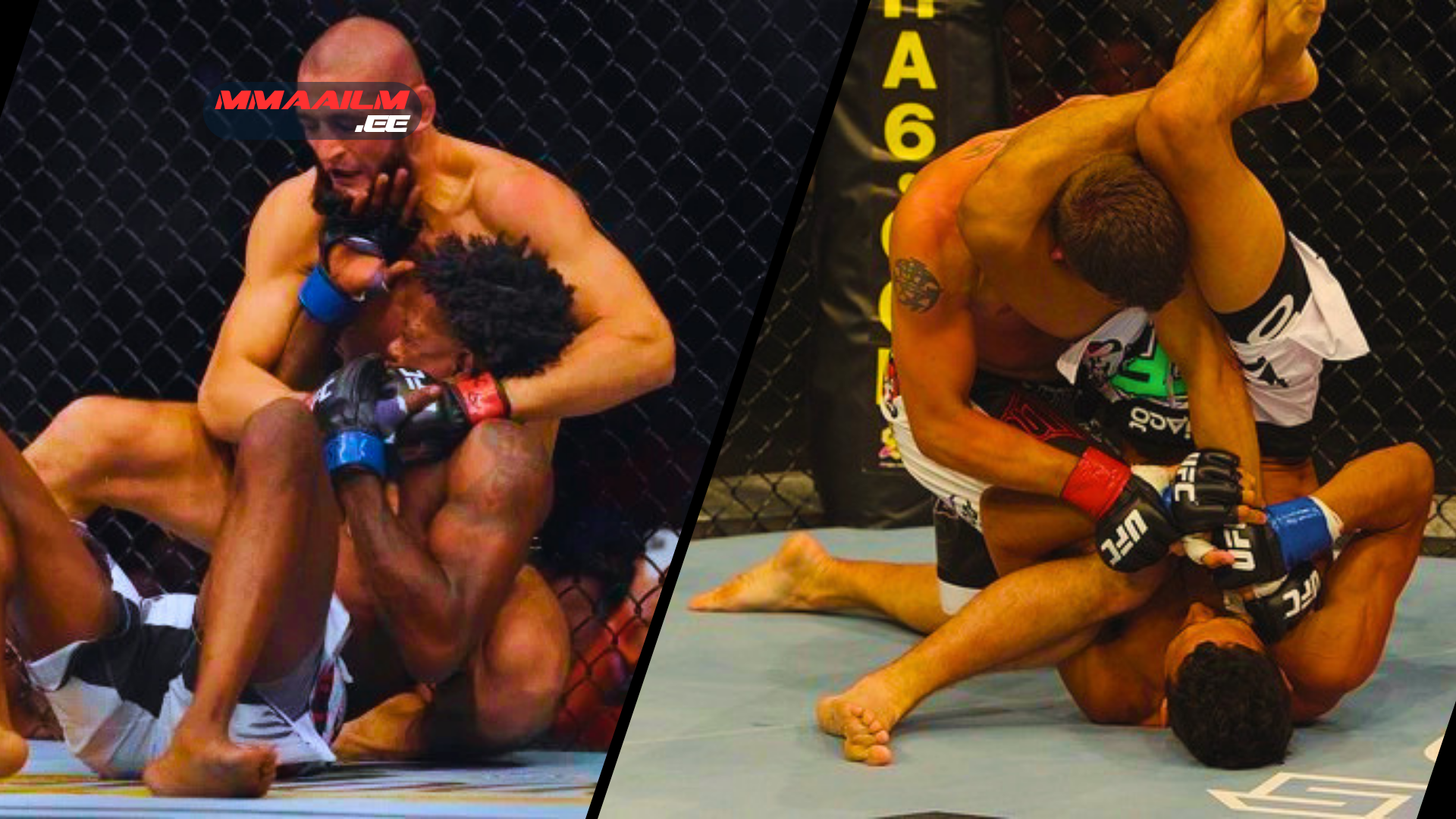
By trapping an opponent against the mesh, the offensive fighter essentially turns a one-on-one grappling exchange into a two-on-one scenario. The cage limits the defender’s angles of escape and alters their center of gravity. Without the ability to step back and widen their base, the defending fighter is forced into an upright, compromised posture. The attacker can then use their own body weight to crush the defender against the rigid structure, utilizing leverage that simply does not exist in the center of the octagon.
Offensive Wall Tactics: Pinning and Takedowns
Effective offensive wall wrestling relies on a strict hierarchy of positional control. The foundation of this control is head positioning. By driving the crown of the head under the defender’s chin, the offensive fighter forces their opponent’s posture upward, breaking their structural alignment and making it incredibly difficult for them to generate power or drop their hips.
From this dominant posture, securing double underhooks—pummeling both arms under the opponent’s armpits—allows the attacker to elevate the defender’s center of gravity. Pinning the hips squarely against the fence is the next crucial step, as it strips the opponent of the mobility needed to circle away.
Once the defender is immobilized, the attacker can begin chaining takedown attempts. If a traditional double-leg takedown fails because the defender widens their stance against the cage, the attacker can seamlessly transition to a single-leg attempt, a body-lock trip, or a high-crotch lift. The fence prevents the defender from sprawling effectively, forcing them to rely on balance and grip-fighting to stay upright.
Dirty Boxing and the War of Attrition
Wall wrestling is not strictly about dragging an opponent to the canvas; it is equally about inflicting damage and draining the opponent’s cardiovascular reserves. The cage clinch is the premier environment for “dirty boxing,” a grueling style of infighting that utilizes short, devastating strikes in tight quarters.
When a fighter is pinned against the fence, their ability to evade strikes is severely restricted. The offensive fighter can use frames—placing a forearm or hand against the opponent’s collarbone or face—to create just enough space to land slicing elbows, short uppercuts, and heavy knees to the thighs and midsection. Foot stomps and shoulder strikes further add to the accumulation of damage.
Beyond the blunt force of strikes, offensive wall wrestling is a war of attrition. By constantly leaning heavily into the trapped opponent, the attacker forces the defender’s legs to carry the weight of two humans. This relentless physical pressure rapidly drains the defender’s energy, often leaving them exhausted even if they manage to survive the round without being taken down.
The Wall Walk: MMA’s Most Essential Escape
Just as the cage provides distinct offensive advantages, it also offers a unique lifeline for a grounded fighter. In traditional Brazilian Jiu-Jitsu, a fighter on their back relies on sweeps and submissions to reverse a bad position. However, in MMA, throwing up a triangle choke or attempting a hip-bump sweep against the fence is often ineffective, as the physical barrier blocks the necessary hip mobility.
Instead, modern fighters rely on the “wall walk.” This defensive mechanic is a step-by-step process of using the fence to safely return to the feet. When taken down near the perimeter, the defending grappler will immediately scoot their hips backward until they make contact with the chain-link mesh.
Once their back is against the wall, the defender posts an arm on the mat and uses the friction of the cage to slide their shoulders upward. They rebuild their base by transitioning from a seated position to a kneeling position, and finally to their feet. Throughout this process, the defending fighter must actively strip the attacker’s waist grips and control their wrists to prevent being dragged right back down to the mat.
Open Mat vs. The Chain-Link Fence
The unique dynamics of the cage explain why elite pure wrestlers and world-class BJJ practitioners often struggle early in their MMA careers. A decorated freestyle wrestler might shoot a perfect blast double-leg in the center of the cage, only to find themselves exhausted and stuck when they try the same technique against a fighter leaning heavily on the fence. Similarly, a BJJ black belt might accept a bottom position near the cage, only to realize their offensive guard is completely neutralized by the barrier restricting their hip movement.
To succeed at the highest levels of mixed martial arts, a fighter must adapt their traditional grappling pedigree to the reality of the cage. Wall wrestling is not just a modification of existing martial arts; it is a distinct, highly technical discipline born out of the physical boundaries of the sport. Whether used to suffocate an opponent with pressure or to engineer a brilliant escape to the feet, mastery of the chain-link fence remains one of the most critical skills in modern combat.