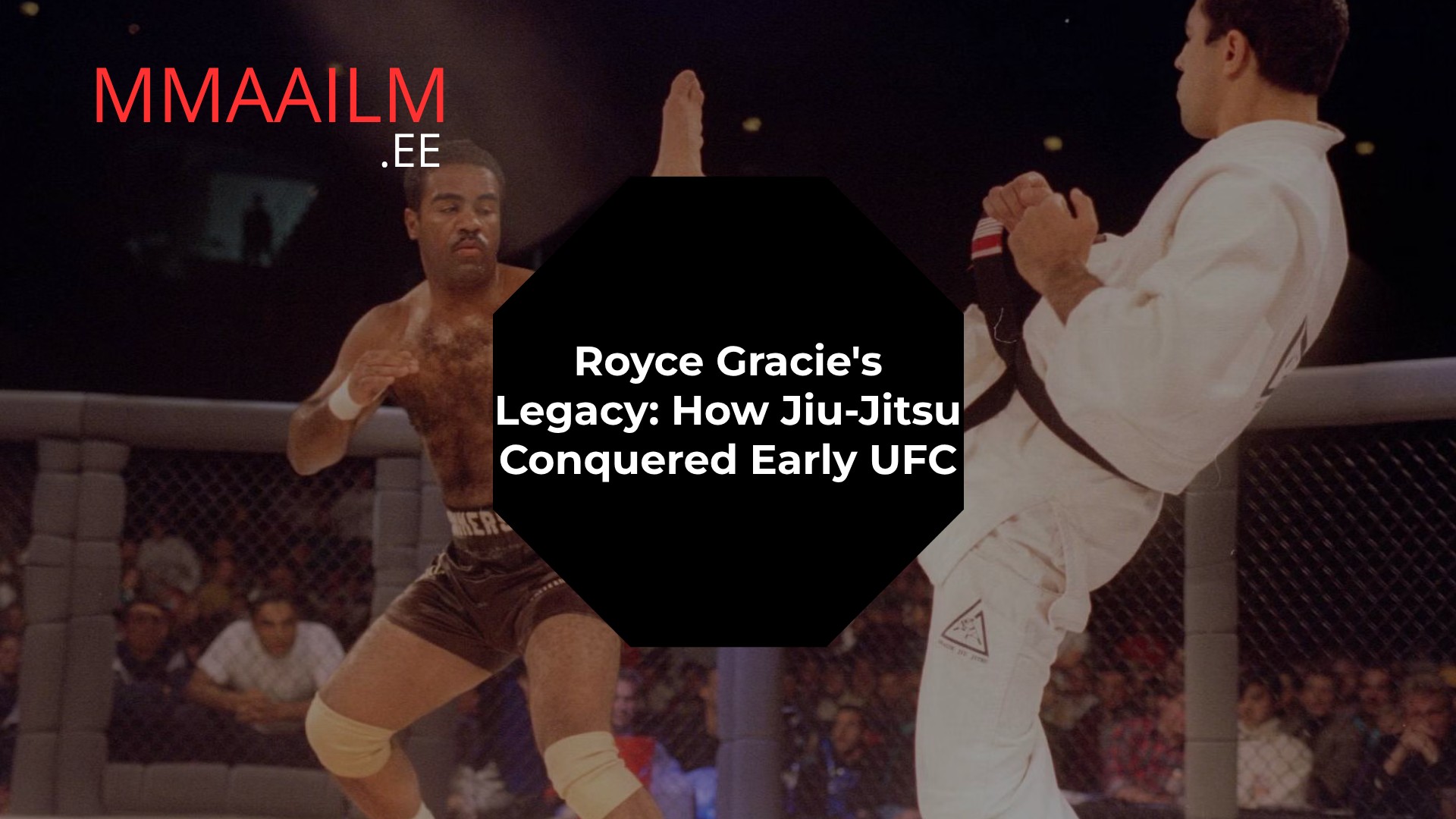
On November 12, 1993, the martial arts world experienced a paradigm shift that permanently altered the landscape of combat sports. Before the inaugural Ultimate Fighting Championship (UFC 1) in Denver, Colorado, the global perception of hand-to-hand combat was largely dictated by Hollywood action films and traditional striking disciplines. That illusion was shattered in a single night by a slender, unassuming Brazilian named Royce Gracie. Wearing a traditional white gi and weighing barely 175 pounds, Gracie dismantled three consecutive opponents to win the tournament, proving that leverage, technique, and ground fighting could overcome massive size and strength advantages. His early octagon performances did not just introduce Gracie Jiu-Jitsu to the world; they birthed the modern sport of mixed martial arts (MMA).
The Illusion of the Action Hero
Prior to 1993, the global martial arts consciousness was dominated by striking arts such as Karate, Taekwondo, Kung Fu, and Boxing. The prevailing belief, heavily reinforced by cinema, was that a real fight would be contested entirely on the feet, characterized by flying kicks, rapid-fire punches, and definitive knockout blows. Grappling was largely viewed through the lens of amateur wrestling or professional wrestling entertainment, with little thought given to submission holds outside of niche circles in Japan and Brazil.
In Brazil, however, the Gracie family had spent decades developing and testing their proprietary system of ground fighting—Gracie Jiu-Jitsu, later known globally as Brazilian Jiu-Jitsu (BJJ). They refined their art in “Vale Tudo” (anything goes) challenge matches, where rules were minimal and weight classes were non-existent. Seeking a global platform to prove the absolute superiority of their family’s system, Rorion Gracie partnered with advertising executive Art Davie to create the UFC, a no-holds-barred tournament designed to answer one question: which martial art is the most effective in a real fight?
The Unlikely Champion: Why Royce Was Chosen
A common historical misconception is that Royce Gracie was the most skilled or physically dominant fighter in his family at the time of UFC 1. In reality, his older brother, Rickson Gracie, was universally acknowledged as the family’s undisputed champion and most formidable competitor. However, Rorion Gracie made a calculated, genius marketing decision by selecting Royce to represent the family.
Royce was chosen specifically because he did not look intimidating. He lacked the muscular physique of a traditional prize fighter. By placing a 170-pound, mild-mannered practitioner into an eight-man tournament featuring towering kickboxers, heavyweight boxers, and massive street brawlers, Rorion maximized the shock value of the event. The early UFC events featured no weight classes, no time limits, no judges, and virtually no rules other than bans on biting and eye-gouging. Royce’s presence was a living thesis statement: technique and leverage can conquer brute strength and size.
The Mechanics of Gracie Jiu-Jitsu in the Octagon
Royce Gracie’s success was not born of chaos, but of a highly systematic, repeatable technical approach. His strategy relied heavily on distance management and neutralizing his opponents’ ability to generate kinetic energy through strikes.
On the feet, Gracie utilized a stomping front kick to the thigh or knee, known as a pisão, to keep dangerous strikers at bay. He would then time his entry, rushing forward to secure a tight clinch. Once attached to his opponent, Gracie effectively smothered their punching power. From the clinch, he utilized fundamental judo trips and body-lock takedowns to drag the fight to the canvas.
Once on the ground, Gracie employed a strict positional hierarchy. He systematically worked to pass his opponent’s legs, securing dominant positions like side control or the full mount. By applying heavy top pressure, he forced his panicked opponents into making technical errors—such as extending an arm or rolling to expose their back—which Gracie would instantly capitalize on with a joint lock or a chokehold.
Redefining the Bottom Position: The Power of the Guard
Perhaps Royce Gracie’s most revolutionary contribution to the global martial arts lexicon was his use of the “guard.” Before UFC 1, being on your back underneath an attacker was universally considered a helpless, losing position in a street fight. Gracie proved that, with the right technique, it could be an offensive and defensive stronghold.
By wrapping his legs around his opponent’s waist from the bottom, Gracie could control their posture, preventing them from raining down effective strikes. He used his legs to off-balance his attackers, sweep them to gain the top position, or submit them directly from his back using triangle chokes and armbars. This concept completely baffled traditional martial artists, who had no conceptual framework for defending attacks originating from a fighter on their back.
Landmark Victories That Changed the Sport
Gracie’s unprecedented 11-fight submission win streak across UFC 1, UFC 2, and UFC 4 provided a highlight reel of technical mastery against much larger men. Several key matchups perfectly encapsulated the effectiveness of his style:
- Art Jimmerson (UFC 1): Gracie faced a highly ranked professional boxer who entered the cage famously wearing a single boxing glove. Gracie quickly secured a takedown and achieved the full mount. Jimmerson, having absolutely no idea how to escape the position or defend himself on the ground, tapped out simply from the overwhelming helplessness of the situation.
- Ken Shamrock (UFC 1): Shamrock was a formidable shootfighter with a significant size advantage and actual submission grappling knowledge. Despite Shamrock’s pedigree, Gracie used the lapel of his own gi to secure a choke from Shamrock’s back, proving his technical grappling was superior even against other trained grapplers of the era.
- Dan Severn (UFC 4): In one of the most famous bouts in early MMA history, Gracie faced a world-class collegiate wrestler who outweighed him by over 80 pounds. Severn took Gracie down and maintained top position, battering him for nearly 15 minutes. However, Gracie remained calm inside his guard, weathered the storm, and eventually locked in a triangle choke that forced the exhausted, massive wrestler to submit.
Dismantling the Myths of the Early UFC
As the legend of Royce Gracie grew, so did several misconceptions about the early days of the UFC. It is vital to separate the historical facts from the promotional folklore.
First, Royce Gracie did not invent Brazilian Jiu-Jitsu. The martial art was adapted from Kodokan Judo by his father, Helio Gracie, and his uncle, Carlos Gracie, decades earlier. Royce was simply the vessel chosen to introduce their life’s work to the North American public.
Secondly, it is a fallacy to claim that early UFC fighters were unskilled brawlers. Many of Gracie’s opponents were world-class athletes in their respective disciplines. Ken Shamrock was a pioneer of Japanese shootfighting; Dan Severn was a highly decorated amateur wrestler; Patrick Smith was a feared kickboxer. Their failure against Gracie was not a lack of martial arts skill, but rather a complete lack of cross-training. They were masters of single disciplines who were suddenly dragged into a realm of fighting they did not understand.
The Legacy of Cross-Training and Modern MMA
Royce Gracie’s dominance in the early 1990s sounded the death knell for the pure, single-discipline martial artist. His tournament victories sent shockwaves through dojos and boxing gyms worldwide. Fighters quickly realized that no matter how lethal their striking was, it was entirely useless if they could be taken down and submitted by a trained grappler.
This realization catalyzed the birth of modern mixed martial arts. To survive in the octagon, strikers were forced to learn takedown defense and submission escapes. Conversely, as the sport evolved, Jiu-Jitsu practitioners were forced to learn kickboxing and wrestling to deal with well-rounded opponents. Today’s MMA champions are highly evolved hybrid athletes, seamlessly blending striking, wrestling, and submission grappling. Yet, the foundation of this modern athletic evolution rests squarely on the shoulders of Royce Gracie, the man who proved that technique conquers all.