The knee strike occupies a unique and devastating space in mixed martial arts. It is the ultimate weapon of the transitional zone, bridging the gap between free-flowing striking and grinding grappling. Because the knee joint is one of the hardest and most dense bones in the human body, a well-placed strike requires very little travel distance to generate fight-ending force. Understanding how to deploy this weapon effectively, however, goes far beyond simply lifting a leg.
In modern MMA, mastering the knee strike demands a deep comprehension of physical mechanics, spatial timing, and positional dominance. Whether used to punish an opponent in the clinch, deter a relentless wrestler, or deliver a spectacular knockout, the knee is a versatile tool that dictates the flow of close-quarters combat.
The Mechanics of Power: Posture and Hip Engagement
A powerful knee strike is not merely an upward flick of the leg; it is a full-body kinetic chain. To generate maximum force, a fighter must actively engage their hips. As the knee rises toward the target, the hips must drive forward, transforming the strike from a rising bump into a piercing spear that penetrates the opponent’s guard.
Footwork and posture play a critical role in this mechanical sequence. The standing foot should pivot slightly outward to open the hips, allowing for a greater range of motion. Simultaneously, the striker must point the toes of the attacking leg downward. This action tightens the calf muscle against the hamstring, hardening the patella and turning the knee into a solid, blunt instrument. To counterbalance the forward drive of the hips, the fighter’s torso leans back slightly, which also pulls their own head out of range of short counter-punches.
Controlling the Target: The Clinch and the Thai Plum
Knees are synonymous with clinch fighting. In the chaotic space of dirty boxing and cage wrestling, controlling an opponent’s posture is the key to landing effective strikes. Without upper-body control, a knee strike can easily be blocked, caught, or countered with a takedown.
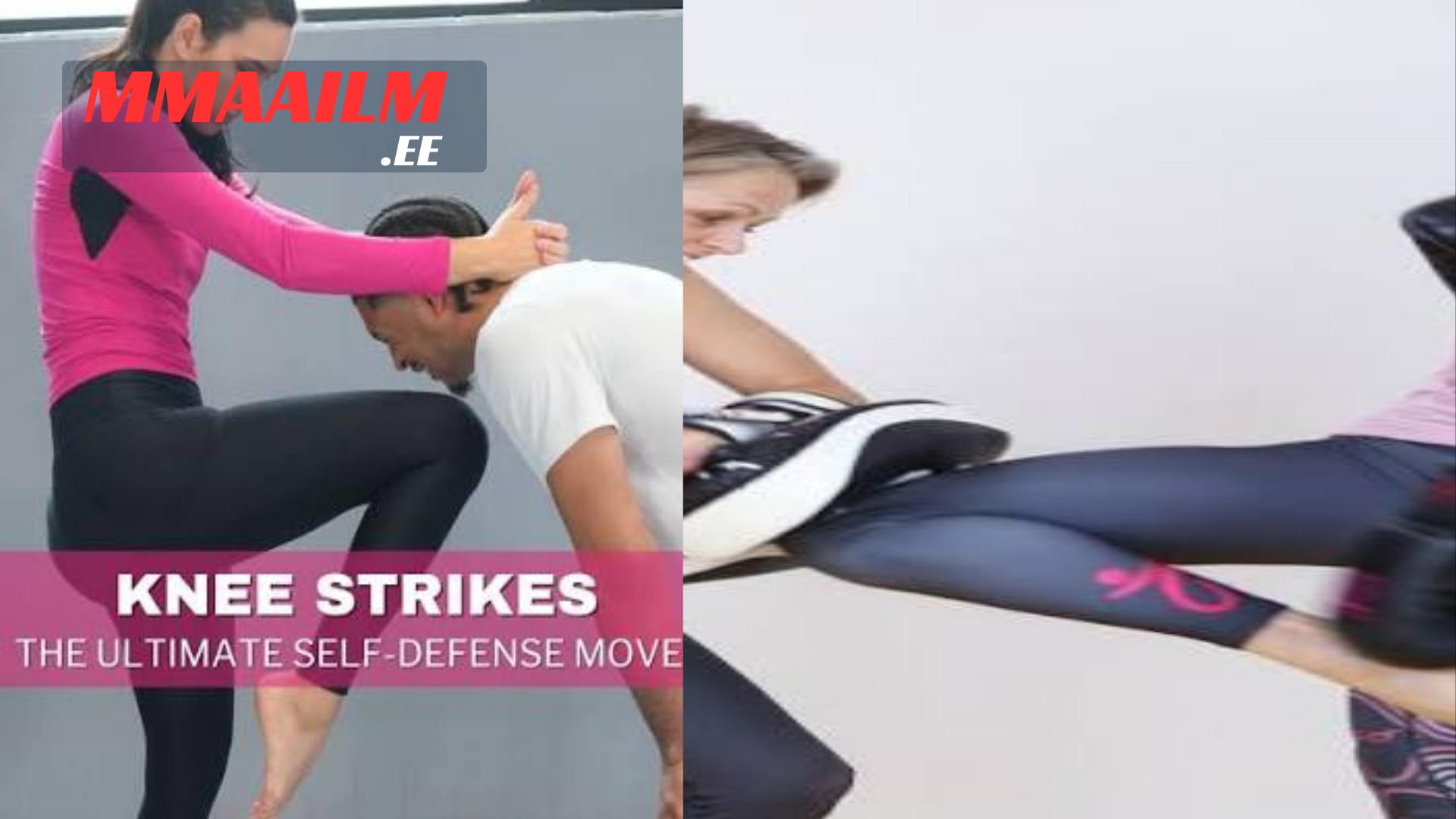
Fighters utilize collar ties to anchor their opponents and create devastating collisions. The double collar tie, commonly known as the Muay Thai plum, involves weaving both hands behind the opponent’s crown, locking the forearms against their collarbones. From this dominant position, a fighter pulls the opponent’s head downward while simultaneously driving the knee upward. This creates a brutal convergence of opposing forces. Even a single collar tie, combined with inside bicep control on the opposite arm, can provide enough leverage to break an opponent’s posture and open their midsection or head to a rising knee.
The Ultimate Deterrent: Intercepting the Takedown
One of the most critical tactical applications of the knee in MMA is its use as an anti-wrestling mechanism. When a grappler changes levels to shoot for a double-leg or single-leg takedown, they must drop their hips and drive their head forward. This predictable trajectory inadvertently places their head directly in the path of a rising knee.
Timing an intercepting knee requires elite spatial awareness and the ability to read subtle level-change cues. A fighter must recognize the drop in the opponent’s shoulders and the shift in their weight. However, this technique carries significant tactical risk. Lifting the lead leg to strike momentarily compromises a fighter’s base and balance. If the knee misses the target or glances off the shoulder, the striker is left standing on one leg, making the takedown nearly impossible to defend. Therefore, the intercepting knee is a high-stakes gamble that relies entirely on precision and timing.
Tactical Targeting: Body Blows vs. Head Strikes
While a knee to the chin often results in a highlight-reel knockout, targeting the body is a highly effective, attritional strategy. Driving knees into the solar plexus, ribs, or liver can quickly deplete an opponent’s cardiovascular reserves. In grueling battles against the cage, short, rhythmic knees to the thighs and midsection systematically break down a fighter’s mobility and willpower.
The choice between targeting the head or the body depends largely on the opponent’s posture. Head strikes generally require the opponent’s posture to be broken down via the clinch, or for them to be actively changing levels. Attempting to knee a fully upright opponent in the head is mechanically difficult and leaves the striker vulnerable. Conversely, body knees are accessible in almost any close-quarters entanglement, making them a reliable tool for wearing down an adversary over three or five rounds.
High Risk, High Reward: The Mechanics of the Flying Knee
The flying knee is one of the most explosive and aesthetically spectacular techniques in combat sports. It involves launching the entire body off the ground to deliver a strike, often utilizing a switch-step to generate upward momentum and disguise the attacking leg.
Mechanically, a flying knee begins with the non-striking leg driving upward to gain altitude. Once airborne, a rapid mid-air scissor motion snaps the attacking knee into the target, transferring the momentum of the jump directly into the strike. Because this technique leaves the attacker completely airborne and unable to sprawl or change direction, it is incredibly dangerous to execute in open space. Tactically, flying knees are best deployed when an opponent is trapped with their back against the fence, severely hurt and covering up, or exhibiting a predictable habit of ducking their head to avoid punches.