In the chaotic, compressed spaces of mixed martial arts, traditional punches often lose their kinetic potential. When the distance collapses and fighters are chest-to-chest, the elbow emerges as the sport’s most devastating and versatile short-range weapon. Unlike the fist, which requires space to accelerate and hinges on the fragile bones of the hand, the elbow utilizes the dense, unyielding olecranon process. Driven by the body’s core rotation, it transforms into a blunt-force instrument capable of ending fights from the clinch, against the cage, or on the mat.
Mastering the elbow requires an intricate understanding of distance management and biomechanics. It is not a weapon of desperation, but a highly technical tool that exploits the transitional zones of combat where opponents feel falsely secure.
The Biomechanics of the Strike: Horizontal, Upward, and Spinning
The power of an elbow strike is not generated by the arm itself, but by the kinetic chain starting from the feet, transferring through the hips, and culminating at the shoulder. Because the lever is shorter than a fully extended punch, the fighter must commit their entire body weight into the rotation to maximize impact.
The horizontal elbow acts as a slashing tool. By flaring the elbow parallel to the floor and rotating the torso, the fighter drives the bone across the target, making it highly effective for bypassing a high guard. The upward elbow, conversely, is designed to split the guard down the middle. Stepping in and driving the elbow vertically toward the ceiling utilizes the legs and hips to generate sudden, upward force, often catching an opponent who is leaning forward or preparing to shoot for a takedown.
Spinning elbows rely on rotational momentum and the element of surprise. By pivoting on the lead foot and turning the back to the opponent, a fighter can use the torque of the spin to whip the rear elbow into a blind angle. This technique is frequently used to counter an opponent aggressively closing the distance or to capitalize on the momentum of a missed strike.
Clinch Warfare and the Collar Tie Trap
The clinch is the natural habitat of the elbow strike. In this phase, fighters use upper-body tie-ups to manipulate posture and create the precise structural angles necessary for short-range impacts. The single collar tie—a grip secured on the back of the opponent’s neck—is one of the most effective setups for elbow strikes.
By securing a collar tie, a fighter establishes a push-pull dynamic. The attacker pulls the opponent’s head downward and forward while simultaneously driving the elbow from the opposite side into the oncoming target. This traps the opponent in the optimal range and doubles the collision force. Furthermore, framing with the forearm against the opponent’s collarbone creates a wedge, maintaining just enough space to chamber and fire the elbow without allowing the opponent to smother the strike.
Ground-and-Pound Geometry and the Vertical Strike
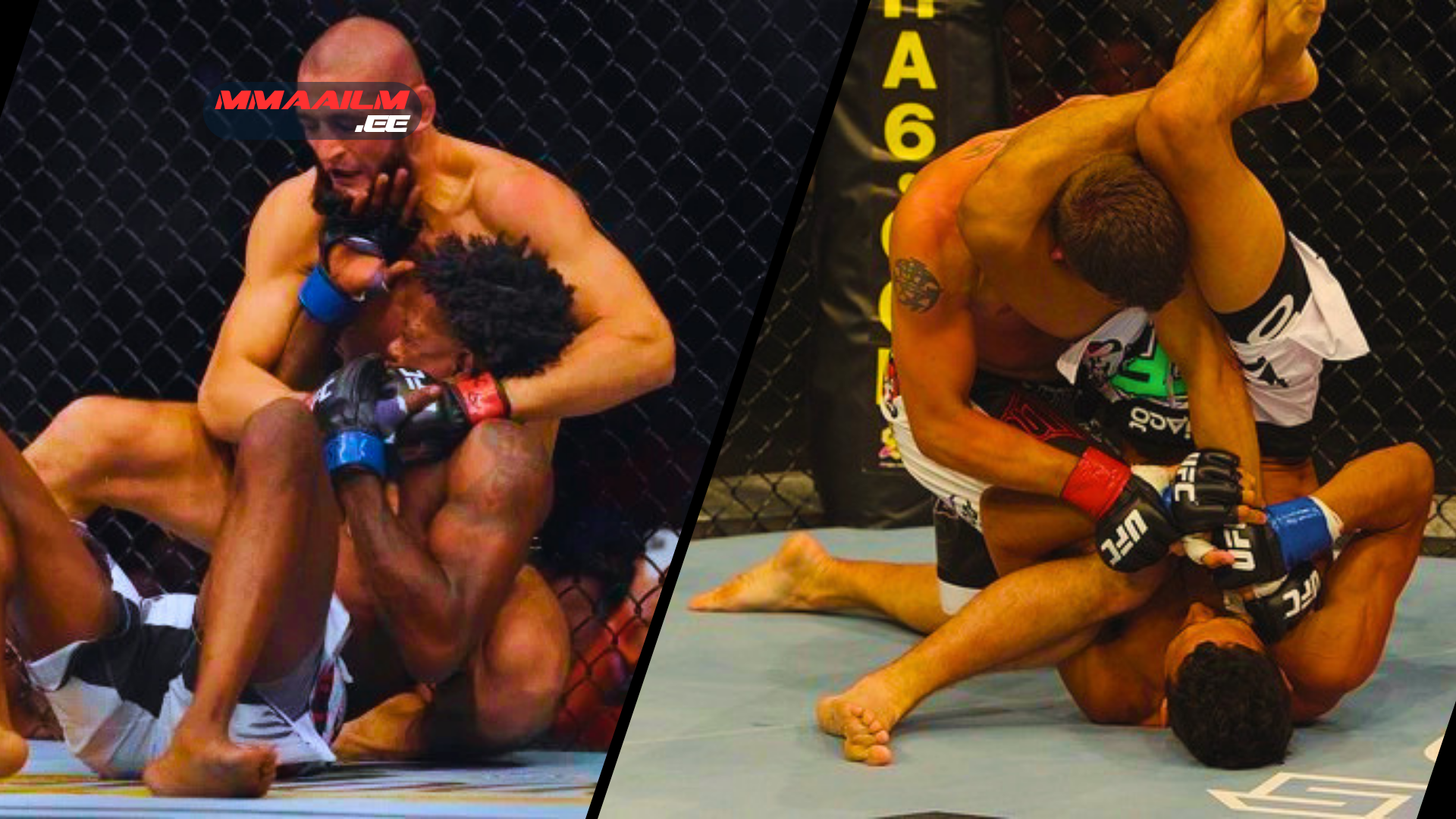
Transitioning to the ground fundamentally alters the mechanics of the elbow. Without the ability to freely rotate the hips, fighters must rely on posture, gravity, and positional control. The half-guard is arguably the most dominant position for ground-and-pound elbows. By pinning one of the opponent’s legs and flattening their hips, the top fighter restricts their movement while keeping their own upper body free to posture up and strike.
With vertical downward elbows firmly established as a standard, legal tactical option in the modern rule set, fighters can fully utilize gravity to pierce through a bottom player’s defensive shell. The geometry of a vertical drop makes it incredibly difficult to deflect from the bottom. Instead of relying on horizontal rotation, the top fighter drops their body weight directly down the centerline. This linear trajectory allows the elbow to slip through the narrow gaps of a tight guard, turning a static top position into a highly efficient finishing sequence.
The Tactical Value of Targeting Cuts
Beyond its concussive power, the elbow is a premier tactical instrument for inducing lacerations. The sharp point of the elbow acts like a scalpel against the taut skin of the forehead, eyebrows, and cheekbones. A well-placed, glancing horizontal elbow is often thrown with the specific intent of opening a cut rather than scoring a knockout.
The strategic value of a cut is immense. Blood flowing into an opponent’s eyes severely impairs their vision and depth perception, forcing them to constantly wipe their face and break their defensive posture. This visual impairment often induces panic and forces the bleeding fighter to abandon their game plan, making them susceptible to secondary attacks. In a grueling, evenly matched contest, a strategic elbow that opens a cut can entirely shift the momentum of the fight.
Defensive Frames: Surviving the Short-Range Onslaught
Defending against elbows requires a complete departure from traditional boxing defense. Slipping and rolling are highly dangerous in elbow range, as moving the head can easily result in leaning directly into the path of a short, dense strike. Survival in the pocket dictates the use of rigid defensive frames.
Fighters must use their forearms to build structural walls, blocking the trajectory of the strike before it accelerates. Controlling the opponent’s biceps—known as a biceps tie—is crucial for stifling the wind-up of an elbow. Additionally, head positioning is a vital line of defense. By burying the head under the opponent’s chin or pressing it tight against their chest, a fighter can smother the space required to chamber the strike, effectively neutralizing the elbow by denying it the room it needs to operate.