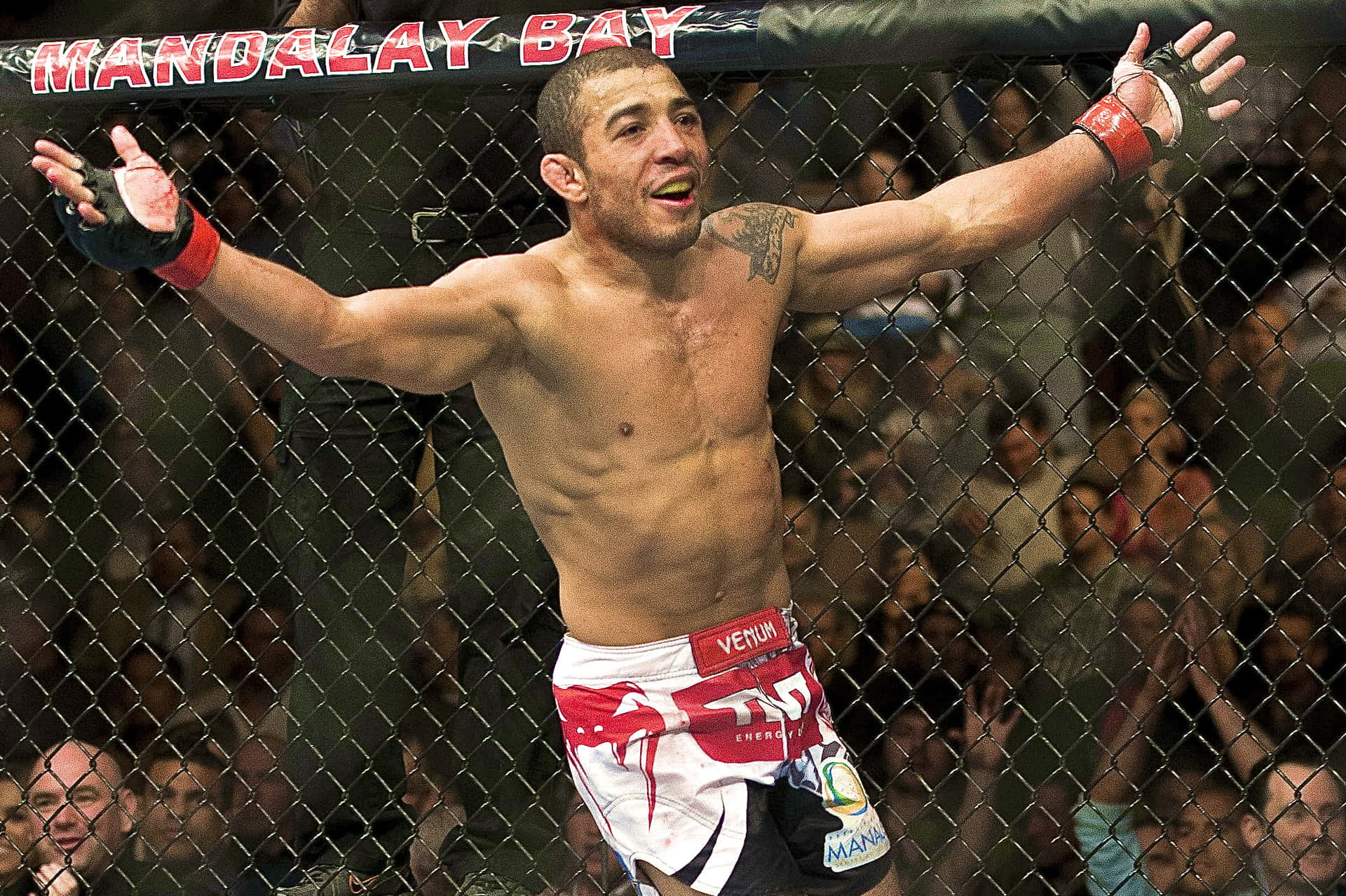
In the unforgiving landscape of Mixed Martial Arts, champions come and go with the changing seasons. But legends? They carve their names into the canvas with blood, sweat, and a dominance that defies time. Jose Aldo is not just a legend; he is the architect of the modern featherweight division and the undisputed “King of Rio.” For over a decade, Aldo didn’t just win fights—he dismantled the very idea that a striker could be taken down.
From the favelas of Manaus to the bright lights of Las Vegas, Aldo’s journey is a masterclass in violence and technique. He reigned unbeaten for 10 years, defending his throne against the absolute best in the world. But beyond the gold belts and highlight-reel knockouts lies a technical genius who changed how MMA is played. Today, we dive deep into the Jose Aldo MMA legacy, analyzing the skills, the stats, and the fighting spirit that made him the greatest featherweight of all time.
The Origin: From the Favelas to the WEC Cage
Jose Aldo da Silva Oliveira Junior was born in Manaus, Brazil, a city deep in the Amazon. His iconic scar—a mark on his left cheek from a childhood barbecue accident—would eventually become a symbol of fear for his opponents. Like many Brazilian legends, Aldo’s path out of poverty began with Jiu-Jitsu. He earned his black belt under the legendary Andre Pederneiras at Nova União, a gym that would become synonymous with lighter-weight dominance.
However, Aldo was never just a grappler. He possessed a terrifying explosiveness that translated perfectly to striking. When he arrived in the World Extreme Cagefighting (WEC) promotion in 2008, he was a force of nature. He didn’t just beat opponents; he obliterated them. His 8-second flying knee knockout of Cub Swanson at WEC 41 remains one of the most violent finishes in history, signaling to the world that a new king had arrived.
The WEC to UFC Transition
When the WEC merged with the UFC in 2010, Jose Aldo was crowned the inaugural UFC Featherweight Champion. Critics wondered if the “smaller” fighters could headline pay-per-views. Aldo answered with a resounding yes. He defended his WEC title twice and then went on to defend his UFC belt seven consecutive times.
His run included victories over a “Who’s Who” of the sport:
- Urijah Faber: Aldo brutalized the “California Kid” with leg kicks in a performance that permanently changed how fighters view low kicks.
- Chad Mendes (2x): A world-class wrestler who was knocked out by a perfectly timed knee in their first meeting and beaten in a “Fight of the Year” war in the rematch.
- Frankie Edgar (2x): The former lightweight champion had no answer for Aldo’s pivot footwork and takedown defense.
The Art of Anti-Wrestling: A Statistical Anomaly
If you want to understand the Jose Aldo MMA legacy, you must look at his takedown defense. For the majority of his career, Aldo maintained a takedown defense rate of over 91%. In a sport dominated by Wrestling in MMA, this number is almost mythical.
How did he do it? It wasn’t just about sprawling. Aldo revolutionized “defensive footwork.”
1. The Pivot and Limp Leg
Unlike traditional wrestlers who sprawl (dropping their hips to the mat), Aldo used his hips to pivot. When an opponent shot for a double leg, Aldo would pivot on his lead foot, swinging his hips away from the attacker. If an opponent grabbed his leg, he would use the “limp leg” technique—relaxing the limb to slide it out of the grip while maintaining his balance.
2. Wall Walking and Frame Control
If he was taken down, he didn’t settle for guard. Aldo was the pioneer of the explosive “wall walk.” He would immediately scramble to the cage, use the fence to stand up, and break the clinch. This ability to reset the fight to the center of the Octagon forced wrestlers to stand and trade with him—a death sentence for most.
The Weapon of Choice: Leg Kicks and Body Shots
While his defense was impenetrable, his offense was destructive. Aldo is arguably the best leg kicker in MMA history. He threw his kicks with a unique Dutch Kickboxing mechanic, pivoting his standing foot to generate maximum torque without telegraphing the motion. His fight against Urijah Faber at WEC 48 is the textbook example of how to cripple an opponent.
Later in his career, as his explosion waned slightly, Aldo reinvented his boxing. He became a master of the “liver shot,” ripping left hooks to the body that folded durable fighters like Jeremy Stephens. This evolution allowed him to remain elite well into his late 30s.
The 13 Seconds and The Resurrection
No career retrospective is complete without addressing UFC 194. In December 2015, Aldo’s 18-fight winning streak was snapped in 13 seconds by Conor McGregor. It was a shocking moment that could have broken a lesser man. But Aldo’s response defined his character.
He returned to win the interim belt against Frankie Edgar. Later, he dropped down to Bantamweight (135 lbs / 61 kg), a move many doubted he could make safely. Yet, he looked rejuvenated. He fought for the title against Petr Yan and secured elite wins over Rob Font and Marlon “Chito” Vera.
Even in his final chapter, the “King of Rio” remained dangerous. His victory over Jonathan Martinez at UFC 301 in Rio de Janeiro (May 2024) was a vintage performance, proving he could still school younger contenders. Although he suffered a split decision loss to Mario Bautista at UFC 307 and a setback against Aiemann Zahabi at UFC 315 (May 2025), his willingness to compete against the next generation solidified his status as a true martial artist.
Where Does Aldo Rank? (GOAT Debate)
The debate for the “Greatest of All Time” (GOAT) in the featherweight division is usually a three-way battle between Jose Aldo, Max Holloway, and Alexander Volkanovski. However, Aldo’s case is unique:
- Longevity: He was a world champion at age 23 and remained a top-5 contender at age 38.
- Level of Competition: He defeated champions from two different generations (Faber/Brown era vs. Mendes/Edgar era).
- Defensive Stats: His ability to nullify grappling is statistically superior to almost anyone in history.
While Volkanovski has the head-to-head win, Aldo’s reign of terror—nine Zuffa title defenses—is a record that stands tall. He didn’t just win; he looked invincible for a decade.
Conclusion: The King Stays the King
Jose Aldo’s impact on MMA goes beyond the numbers. He taught the world that takedown defense is a prerequisite for striking greatness. He showed that a fighter could evolve from a wild brawler to a refined boxer. Whether he was landing a flying knee or stuffing a shot from a D-1 wrestler, Aldo moved with a grace that was terrifyingly beautiful.
As we look back at his storied career, one thing is certain: The King of Rio may have left his gloves in the octagon, but his blueprint for fighting will be studied forever.
FAQ: Jose Aldo’s Career
1. How many times did Jose Aldo defend his title?
Jose Aldo successfully defended his WEC featherweight title twice and his UFC featherweight title seven times, for a total of nine successful title defenses under the Zuffa banner.
2. What is Jose Aldo’s fight record?
As of late 2025, Jose Aldo’s professional MMA record stands at approximately 32 wins and 10 losses. His most notable run was an 18-fight winning streak that lasted from 2006 to 2015.
3. Why is Jose Aldo called the “King of Rio”?
Aldo earned the nickname “King of Rio” because of his dominance while fighting out of Rio de Janeiro and his hero status in Brazil. His celebration at UFC 142, where he ran into the crowd in Rio after knocking out Chad Mendes, cemented this title.
4. Did Jose Aldo ever fight at Lightweight?
Aldo competed primarily at Featherweight (145 lbs) and later Bantamweight (135 lbs). While he teased a move to Lightweight (155 lbs) early in his career to fight legends like Pettis, he never officially campaigned in the UFC Lightweight division.
5. Is Jose Aldo a black belt in BJJ?
Yes, Jose Aldo is a black belt in Brazilian Jiu-Jitsu under Andre Pederneiras. He is also a highly decorated grappler, having won the Copa do Mundo de Jiu-Jitsu before transitioning fully to MMA.