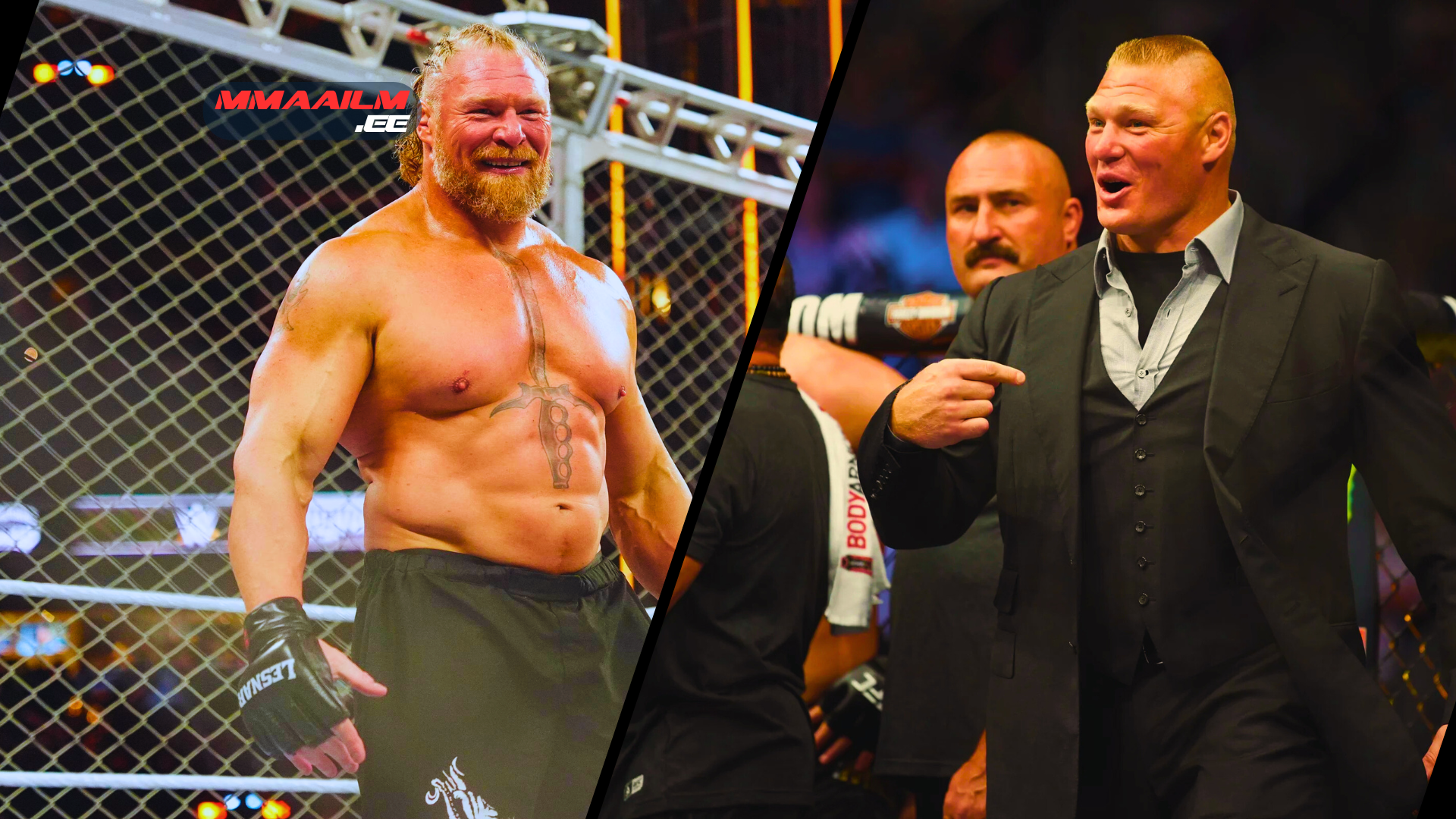
In the annals of combat sports history, few figures have been as polarizing, physically imposing, or financially impactful as Brock Lesnar. A quick glance at Brock Lesnar’s UFC record reveals a modest tally: 5 wins, 3 losses, and 1 No Contest. To the uninitiated, this might look like the resume of a journeyman. But to anyone who witnessed his reign between 2008 and 2011, those numbers tell a completely different story.
Lesnar was not just a fighter; he was an anomaly. A 265-pound NCAA Division I wrestling champion with the speed of a lightweight and the brute force of a silverback gorilla. He crossed over from the scripted world of WWE to the legitimate violence of the Octagon and, against all odds, captured the UFC Heavyweight Championship in only his fourth professional fight.
This article breaks down the career of the “Beast Incarnate,” examining how he legitimized the heavyweight division, battled a life-threatening illness, and became the biggest pay-per-view draw of his era.
The Anomaly: From WWE Superstar to Cage Fighter
Before 2007, the idea of a pro wrestler transitioning to high-level MMA was often met with skepticism. While Japanese promotions like PRIDE FC had mixed success with crossover stars, the UFC audience was more purist. They valued technique over spectacle. Brock Lesnar forced them to respect both.
After a lone win in K-1 against Min Soo Kim, Lesnar signed with the UFC. He didn’t ask for a tune-up fight. He asked for a former champion. At UFC 81, he faced Frank Mir. The fight lasted 90 seconds, but it was a revelation. Lesnar secured a takedown effortlessly and hammered Mir with ground-and-pound that looked like it could crack the floorboards. However, a lack of submission defense cost him; Mir caught him in a kneebar, forcing a tap.
Lesnar was 0-1 in the UFC. Critics laughed. But veterans of the sport saw something terrifying: a man who could dictate where a fight took place simply by willing it so.
The Rapid Rise to Gold
Lesnar’s learning curve was vertical. In his next bout, he mauled veteran Heath Herring, breaking Herring’s orbital bone with the very first punch of the fight. It was a display of raw athleticism that silenced the doubters. This victory set up a title shot against the legendary Randy Couture at UFC 91.
Couture was a technician, a master of the clinch, and a multi-division champion. Lesnar was a tank. In the second round, a glancing right hand from Lesnar sent Couture down. The follow-up shots were academic. In just his fourth pro fight, Brock Lesnar was the UFC Heavyweight Champion.
- UFC 81: Lost to Frank Mir (Submission)
- UFC 87: Defeated Heath Herring (Decision)
- UFC 91: Defeated Randy Couture (TKO – Won Title)
UFC 100: The Peak of the Beast
If there is one night that defines Brock Lesnar’s MMA career, it is July 11, 2009. UFC 100. The promotion’s centennial event needed a headliner that transcended the sport, and they got it in the rematch between Lesnar and Frank Mir.
The build-up was vitriolic. The fight was one-sided. Lesnar used his superior wrestling to pin Mir against the cage, controlling his wrists and raining down short, heavy punches until the referee intervened. It wasn’t just a win; it was a beatdown. The event reportedly drew 1.6 million PPV buys, a record that stood for years until the Conor McGregor era.
The Battle with Diverticulitis
Just as Lesnar seemed invincible, his body failed him. In late 2009, he fell ill with a severe case of diverticulitis, a digestive disease that caused a hole in his colon. Fecal matter was leaking into his abdominal cavity. His immune system was shutting down.
Doctors later revealed that he was hours away from death. He underwent surgery to remove a large section of his colon. For most athletes, this would be a career-ender. For Lesnar, it was a hurdle. He returned at UFC 116 to face Shane Carwin, a man with hands like cinder blocks. After surviving a brutal first-round beating, Lesnar smiled, took Carwin down in the second, and submitted him with an arm-triangle choke.
It was his last win as a champion. The disease had taken a toll on his body’s ability to absorb punishment and cut weight effectively. For more on the health risks fighters face, read our guide on MMA injuries and health risks.
The Fall: Velasquez and Overeem
A diminished Lesnar met Cain Velasquez at UFC 121. Velasquez, with his cardio and relentless pace, was the kryptonite to Lesnar’s explosive style. Brock was TKO’d in the first round. A subsequent fight against Alistair Overeem saw Lesnar hesitant and body-shy; a kick to the liver folded him, ending his first run in the sport.
He retired in the cage, citing his illness and a promise to his family. He returned to WWE, his legacy as a fighter seemingly closed.
UFC 200: A Controversial Return
In 2016, the UFC needed a star for UFC 200. Lesnar was granted a “one-off” opportunity to fight Mark Hunt. Despite a five-year layoff, Lesnar dominated the “Super Samoan” with wrestling, winning a unanimous decision. He earned a disclosed purse of $2.5 million, the highest in history at the time.
However, the victory was short-lived. Lesnar tested positive for clomiphene, a banned substance. The result was overturned to a No Contest, and Lesnar was suspended. It was a sour note to end a legendary career, but it didn’t erase the impact he had made.
Brock Lesnar’s Legacy in Numbers
Why does a 5-3 record matter? Because context is king. Lesnar never fought a “can.” Every opponent he faced in the UFC was either a champion or a top contender. He brought eyeballs to the sport that no one else could. He showed that high-level folkstyle wrestling is the best base for MMA dominance.
Complete Fight Record
- Win: Min Soo Kim (Submission) – K-1 Hero’s
- Loss: Frank Mir (Submission) – UFC 81
- Win: Heath Herring (Decision) – UFC 87
- Win: Randy Couture (TKO) – UFC 91
- Win: Frank Mir (TKO) – UFC 100
- Win: Shane Carwin (Submission) – UFC 116
- Loss: Cain Velasquez (TKO) – UFC 121
- Loss: Alistair Overeem (TKO) – UFC 141
- NC: Mark Hunt (Overturned) – UFC 200
Lesnar proved that heavyweights could move like welterweights. He paved the way for modern athletic giants like Tom Aspinall and Ciryl Gane. For a deeper look at the current heavyweight landscape, check out our analysis of Tom Aspinall vs Ciryl Gane.
FAQ: Brock Lesnar in the UFC
What is Brock Lesnar’s official UFC record?
Brock Lesnar’s official professional MMA record is 5 wins, 3 losses, and 1 No Contest. All of his losses came against former UFC Heavyweight Champions (Frank Mir, Cain Velasquez, and Alistair Overeem).
Who did Brock Lesnar beat for the title?
Lesnar defeated Randy Couture via TKO in the second round at UFC 91 on November 15, 2008, to win the UFC Heavyweight Championship.
Did Brock Lesnar really have 12 inches of his colon removed?
Yes. Due to severe diverticulitis, Lesnar underwent surgery to remove approximately 12 inches of his colon. This significantly impacted his ability to train and absorb body shots in the latter part of his career.
Why was his win over Mark Hunt overturned?
Lesnar originally won the fight by unanimous decision at UFC 200. However, he failed two drug tests for clomiphene (an anti-estrogen blocker). The Nevada State Athletic Commission overturned the result to a No Contest.