When James Toney stepped into the Octagon at UFC 118, he wasn’t just a boxer; he was a legend of the ring. A three-weight world champion with granite hands and defensive wizardry. Yet, against Randy Couture, the fight lasted barely three minutes. Toney didn’t land a single significant punch. He was taken down, dominated, and submitted.
That night proved a brutal truth: Boxing for MMA is not the same sport as boxing in the ring.
In the chaotic environment of mixed martial arts, the “Sweet Science” undergoes a violent evolution. The stance changes. The distance stretches. The defense transforms. Yet, despite these hurdles, boxing remains the primary finishing tool in the UFC. From Conor McGregor’s sniper-like left hand to Max Holloway’s record-breaking volume, the hands often decide who sleeps and who gets their hand raised.
This guide dives deep into the technical adjustments required to adapt pure boxing for the cage, analyzing the stances, defenses, and strategies that separate the elite MMA strikers from the fish out of water.
The “MMA Distance” Trap: Range and Rhythm
The first shock for a pure boxer transitioning to MMA is the distance. In a boxing ring, you are safe standing just outside your opponent’s arm reach. In the Octagon, that same spot is the “kill zone” for a calf kick or a shooting takedown.
MMA is fought at a “kickboxing range,” which is roughly one step further back than boxing range. This seemingly small difference changes the physics of the jab. To land a jab in MMA, you must cover more ground, often lunging or exploding forward, which leaves your hips exposed to a double-leg takedown.
This creates a tactical dilemma: To punch, you must enter the danger zone.
Stance & Footwork: The Anti-Wrestler Adjustment
If you stand like a traditional boxer in the UFC, you will spend the night staring at the arena lights. The classic boxing stance—bladed (side-on), feet narrow, weight often heavy on the lead leg—is a wrestler’s dream.
The Square Hips Rule
In MMA, the hips must remain relatively square to the opponent. Why? Because you need to sprawl. If your hips are bladed, it takes precious milliseconds to turn and drop your weight on a takedown attempt. By the time you adjust, you are already on the canvas.
Key Adjustments:
- Wider Base: Fighters keep their feet wider apart than boxers to maintain balance against leg kicks and takedowns.
- Lower Center of Gravity: Unlike the upright posture of a Muay Thai fighter or the bouncing rhythm of an amateur boxer, MMA strikers often crouch slightly to protect their legs and prepare for the sprawl.
- Hand Position: While boxers often tuck their chin behind a high shoulder (the Philly Shell), this leaves the legs exposed. MMA fighters often keep their hands slightly lower and further out to frame against a grappling entry.
The Exception: Sean Strickland
Sean Strickland defies these laws. He stands tall, walks forward with an upright torso, and utilizes a modified “Philly Shell” to parry punches. His success comes from his relentless pressure and ability to check kicks instantly, proving that rules in MMA are made to be broken—if you have the cardio to back it up.
Defense in 4oz Gloves: The Myth of the Shell
The 4oz (113 g) MMA glove changes everything about defense. In boxing, huge 10oz or 12oz gloves act as shields. You can hide behind a high guard (earmuffs) and absorb heavy shots with minimal damage.
In MMA, the gloves are tiny. They don’t cover the temple or the chin effectively. A punch can easily slip *through* a high guard. Furthermore, the impact isn’t dispersed; it’s concentrated. relying on a static shell in MMA is a recipe for a TKO.
Head Movement vs. The Head Kick
“Move your head!” shouts the boxing coach. But in MMA, slipping a punch can be fatal. If you slip to your right to avoid a jab, you might be leaning directly into a left high kick.
This is why defensive responsibility in MMA prioritizes distance management and active framing over slipping and rolling. Fighters like Dustin Poirier use a “shifting” defense, rolling with punches while simultaneously moving their feet to change angles, ensuring they don’t get pinned on the cage.
The “Dirty Boxing” Phase: Fighting in a Phone Booth
Pure boxing forbids holding and hitting. In MMA, this range—the clinch—is where fights are often won. This is “Dirty Boxing.”
When the distance closes, an MMA fighter doesn’t look for a referee break; they look for a collar tie. By grabbing the back of the opponent’s neck, a fighter can control their posture and rain down uppercuts and short hooks.
Randy Couture revolutionized this in the early 2000s, but modern fighters have perfected it. They use the “single collar tie” not just to strike, but to off-balance their opponent, blending strikes with trips and throws. If a boxer gets stuck here without grappling knowledge, their superior hand speed is useless because their posture is broken.
Profiles in Excellence: The 3 Kings of MMA Boxing
To understand how to adapt boxing for MMA, watch the film of these three masters who have successfully translated the sweet science into cage dominance.
1. The Volume King: Max Holloway
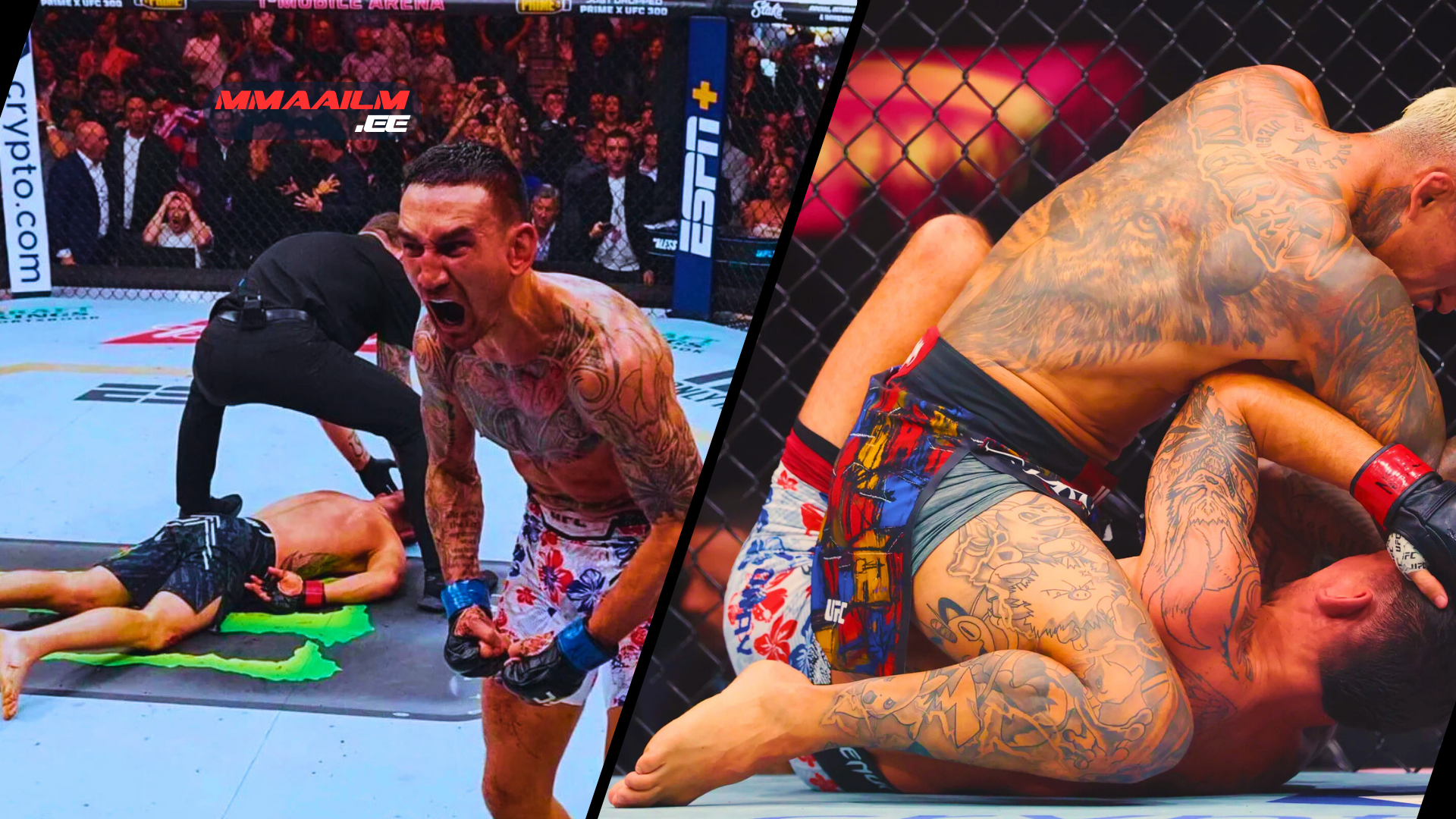
Max “Blessed” Holloway is the ultimate example of weaponized cardio. He doesn’t rely on one-punch knockout power; he relies on drowning his opponents in an ocean of volume. His record-breaking performance against Calvin Kattar, where he landed a staggering 445 significant strikes, showcased the power of the jab and non-stop movement.
The Lesson: Body work and volume can break an opponent’s will faster than a single power shot.
2. The Pocket Scientist: Dustin Poirier
Dustin Poirier brings a brawling style refined by elite technique. He is a master of the “shift,” changing his stance mid-combination to maintain power while moving forward. His defense is a modified “shell” that utilizes his shoulders and elbows to deflect shots (similar to the frantic parrying of George Foreman) before returning fire with devastating hooks.
The Lesson: You can brawl, but you must be technically sound in the pocket to survive the exchanges.
3. The New Prototype: Ilia Topuria
Ilia Topuria represents the modern evolution of MMA boxing. With a background in Greco-Roman wrestling, he has no fear of the takedown, allowing him to sit down on his punches with terrifying power. His “tight” boxing style—compact hooks, heavy combinations, and disciplined head position—is a nightmare for opponents because he can switch from a knockout artist to a grappler in a split second.
The Lesson: The best base for boxing in MMA is actually wrestling, because it gives you the confidence to let your hands go.
Conclusion: The Hybrid Striker
Boxing is an indispensable pillar of Mixed Martial Arts. It is the art of hitting and not getting hit. But to work in the cage, it must be stripped down and rebuilt. The stance must account for kicks; the defense must account for small gloves; and the offense must account for the threat of the takedown.
The fighters who master this hybrid—who can jab like a boxer, sprawl like a wrestler, and clinch like a Muay Thai fighter—are the ones wearing gold in 2026. The days of the “pure boxer” in MMA are long gone, but the era of “Boxing for MMA” is just beginning.
FAQ: Boxing for MMA
Is Boxing or Muay Thai better for MMA?
Neither is “better” in isolation; they are both essential pieces of the puzzle. Muay Thai provides the clinch, knees, and kicks necessary for distance management, while boxing provides the footwork, head movement, and hand speed to finish fights in the pocket. The most successful champions, like Anderson Silva or Jon Jones, blended both seamlessly.
Can a pro boxer transition to the UFC?
History suggests it is extremely difficult. While boxers possess elite hand speed, they lack the “sprawl” muscle memory required to stop takedowns. Without years of wrestling and grappling training, a pro boxer is vulnerable to being taken down and submitted, as seen in the James Toney vs. Randy Couture fight.
Why don’t MMA fighters jab more?
Actually, the jab is the most used strike in MMA! However, it looks different. MMA fighters often use a “pawing” jab to measure distance rather than a stiff, snapping jab, because over-committing to a jab can leave the lead leg exposed to a calf kick. Fighters like Georges St-Pierre and Kamaru Usman used the jab brilliantly to set up their takedowns.
Is the “Philly Shell” effective in MMA?
Generally, no. The Philly Shell relies on a lead shoulder tuck and a bladed stance, which exposes the lead leg to heavy kicks and the hips to takedowns. While fighters like Bobby Green and Sean Strickland have used variations of it successfully, it requires exceptional reflexes and is considered high-risk for the average fighter.